

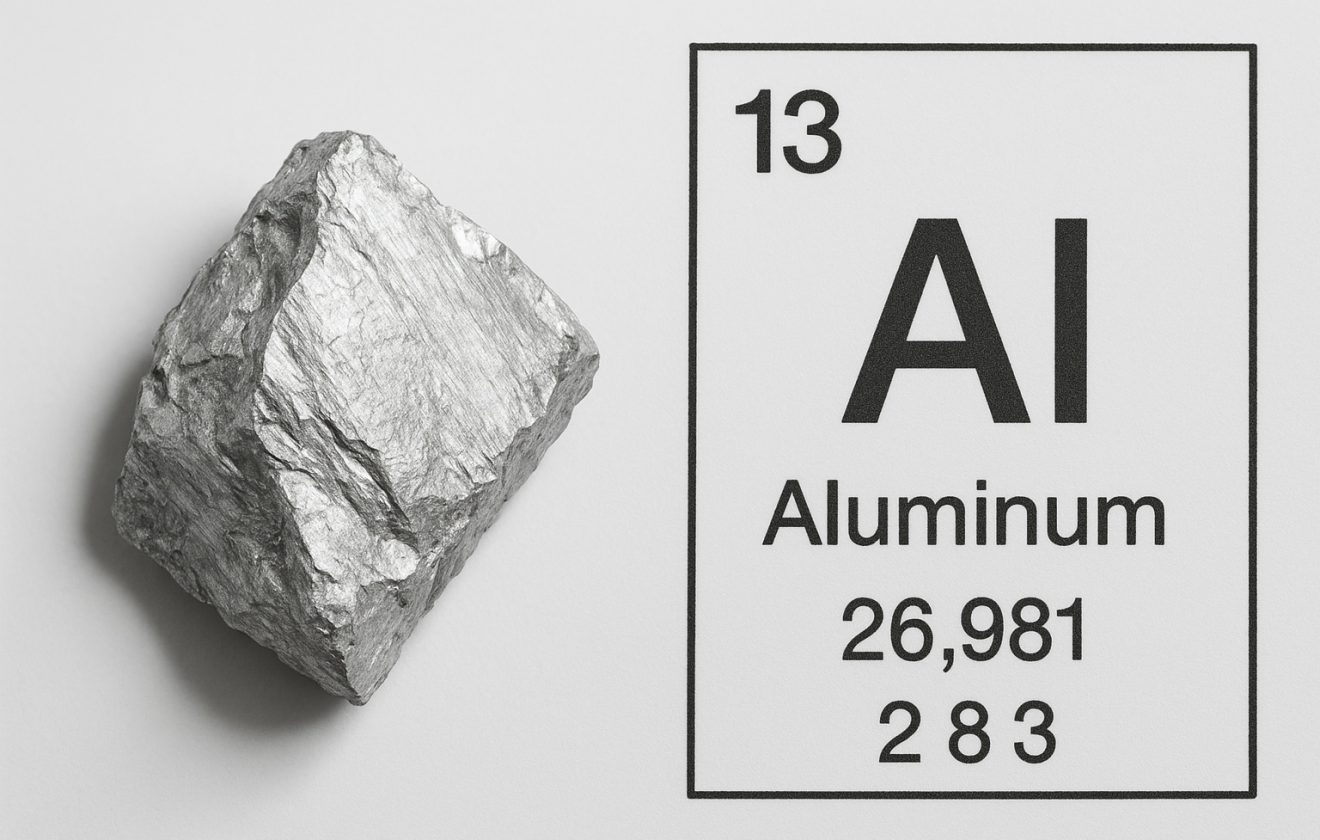
Aluminium (from alumen, meaning alum) is the chemical element Al, belonging to Group III of the Mendeleev periodic table.
Its atomic number is 13, and its atomic mass is 26.9815. In nature, aluminium occurs mainly as the stable isotope ²⁷Al. It also has several radioactive isotopes produced artificially, the longest-lived of which is ²⁶Al, with a half-life of 740,000 years.
Aluminium is a silvery-white metal and a good conductor of electricity. Its melting point is 660.4°C, its boiling point is 2500°C, and its density is 2700 kg/m³ at 20°C. Pure aluminium was first obtained in 1825 by the Danish scientist Hans Christian Ørsted. It does not occur in nature in its pure form. In combined form, aluminium makes up about 8.8 percent of the Earth’s crust by mass.
Its most important natural compounds, especially aluminosilicates, include kaolin, albite, anorthite, orthoclase, biotite, muscovite, corundum (aluminium oxide), and bauxite. Major aluminium deposits are found in Hungary, France, Italy, the United States, and the CIS countries. In Tajikistan, aluminium reserves occur in the form of bauxite in Romit and Qaratoғ, and as syenite in the Rasht mountain region. The nepheline syenites of the Yasmand Valley may also be used as raw material for aluminium production.
In industry, including at the State Unitary Enterprise Tajik Aluminium Company (TALCO), aluminium is produced by the electrolysis of aluminium oxide (Al₂O₃), technically known as alumina, in molten cryolite (Na₃AlF₆) at about 950°C.
Aluminium is a highly reactive metal. For this reason, it readily oxidizes in air and becomes coated with a protective layer of aluminium oxide. This oxide film protects it from corrosion and from the action of various substances such as water vapor and carbon dioxide in the atmosphere. In its compounds, aluminium is generally trivalent. If the oxide film is removed, aluminium reacts with water, releasing hydrogen. Its hydrogen compounds, or hydrides, are reactive and are used in chemical synthesis.
As an amphoteric element, aluminium reacts with both acids and alkalis. It dissolves well in dilute acids such as hydrochloric acid. However, the protective oxide film prevents it from dissolving in oxygen-containing acids such as nitric acid. Aluminium also dissolves in alkalis, forming aluminates. In the process of aluminothermy, aluminium reduces a number of metals and nonmetals from their oxides while releasing a large amount of heat, sometimes reaching 3500°C.
Aluminium compounds are widely used in industry and agriculture. Large amounts of aluminium are used in the production of alloys. Among the most important are duralumin and silumin. Aluminium and its alloys are used in the manufacture of aircraft, rockets, ships, chemical equipment, electrical wires, capacitors, radios, televisions, household utensils, doors, and windows. Thin aluminium sheets are widely used in the food and pharmaceutical industries as packaging material.
Powdered aluminium oxide, known as alumogel, is hygroscopic and is used for drying gases and purifying sugar solutions. Aluminium sulfate is used in water treatment. Aluminium alums are applied in leather tanning and textile dyeing. Aluminium phosphide (AlP) is used in food storage facilities to eliminate mice and rats. Aluminium carbide (Al₄C₃) decomposes water with the release of methane gas. Adding a certain amount of aluminium to steel increases its resistance to high temperatures.
As a component of aluminosilicates, aluminium is one of the important elements involved in soil formation. It is also present in the tissues and intercellular fluids of plants and animals. In soil and in the human body, aluminium can form compounds with phosphate ions that are only slightly soluble, such as variscite (Al(OH)₂H₂PO₄), which may interfere with the absorption of phosphorus. A person consumes about 40 mg of aluminium per day through food.
Research on the production of pure aluminium and its alloys is being carried out at the Institute of Chemistry of the Academy of Sciences of Tajikistan.