

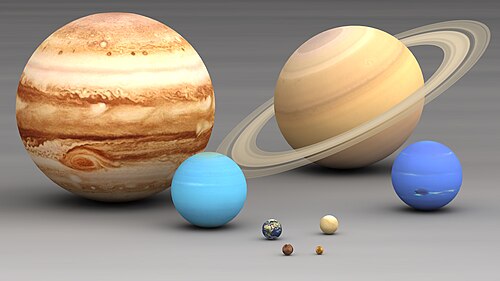
Comparison of Earth with other planets in the Solar System
- History of discovery
unknown
- Perihelion
147 095 000 ± 1 000 km
- Aphelion
151,930,000 ± 10,000 km, 1.00000261 ± 0 astronomical units[3] and 152,098,231,559.14 m
- Great pole (a)
149 597 870 700 м ва 149 598 023 ± 1 км
- Exit from the orbital center (e)
0,016710219 ± 0
- Orbital rotation period
365.256363004 days
- Kepler orbital elements (i)
0,12 рад ва 0,028 рад
- The following are examples:
Transiting Exoplanet Survey Satellite[d], Telstar 18V[d], Kordylewski cloud[d], TerraSAR-X[d], Libertad 1[d], Soil Moisture Active Passive[d], SPOT 1[d], GSAT-18[d], QUESS[d], Van Allen Probe A[d], Van Allen Probe B[d], Sentinel-2B[d], GRACE-1[d], GRACE-2[d], GRACE-FO 1[d], GRACE-FO 2[d], Seeker[d], Sentinel-6 Michael Freilich[d], Sentinel-6B[d], Enxaneta[d], SAMPAN I[d], 2024 PT5[d], 2020 CD3[d], 2022 NX1[d], 2006 RH120[d], Skylab[d], мадори заминисто, Salyut 1[d], STS-90[d], Soil Moisture and Ocean Salinity[d], ADM-Aeolus[d], Explorer 4[d], Salyut 5[d], Vanguard 2[d], Explorer 6[d], geosynchronous satellite[d], Kosmos 557[d], ESA-GEOS 2[d], мадори заминмарказӣ[d], Landsat 1[d], Wide-Field Infrared Explorer[d], AMSAT-OSCAR 7[d], ITAMSAT[d], Tiangong-2[d], DODGE[d], Landsat 5[d], Taiyin[d], e-st@r[d], artificial satellite of the Earth[d], Sentinel-1A[d], UniSat 6[d], AsiaSat 8[d], geostationary satellite[d], SpaceX CRS-9[d], Sentinel-2A[d], Sentinel-1B[d], SGDC-1[d], X-ray Imaging and Spectroscopy Mission[d], Asgardia-1[d], SXM-8[d], Orbital Reef[d], Starlab[d], LEDsat[d], Unisat 5[d], AstroBio CubeSat[d], Space Travelling Egg-Controlled Catadioptric Object[d], Spei Satelles[d], Haven-1[d], Gaofen 12-04[d], Gaofen 12-02[d], Kosmos 2553[d], Ariane flight VA262[d], Fram2[d], Lemu Nge[d], Sentinel-1C[d], PROBA-3 Coronagraph[d], PROBA-3 Occulter[d], SXM-9[d], Blue Ring Pathfinder[d], Active Magnetospheric Particle Tracer Explorers[d], Aqua[d], Array of Low-Energy X-
- Polar compression
0,0033528 ± 0
- Mass (m)
5,972.37 ± 0.01 iotagrams
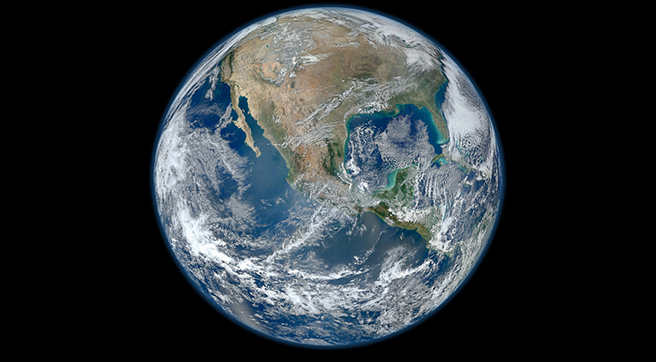
Earth (Persian: زمین; from zam, meaning “cold,” hence zamin — “cold” or “cool-colored”) is one of the planets of the Solar System. It is the third planet from the Sun and the fifth largest by volume among the planets of the Solar System. What fundamentally distinguishes Earth from the other planets is the presence of life. Its astronomical symbol is 🜨.
Early ideas and the first investigations of Earth#
To ancient people, Earth appeared to be a broad and flat body situated at the center of the universe and covered above by the dome of the sky. This simple view dominated for a very long time and even entered certain religious conceptions. Over time, however, the ancient world also developed a range of scientific and philosophical ideas about the shape, size, and place of Earth in the cosmos. Some of these ideas became surprisingly advanced and were supported by observation and practical reasoning. Scholars of this later period understood that Earth was spherical and suspended in space.
Around the 6th to 5th centuries BCE, the Greek thinker Pythagoras is said to have argued that Earth was round. In the 2nd century BCE, Crates of Mallus constructed the first known artificial model of Earth — a globe. Later, Ptolemy described methods for making such a globe in greater detail. After him, the first scholar known to have built a truly scientific globe was Abu Rayhan al-Biruni. The size of Earth — especially its circumference and radius — was first measured by Greek scholars such as Eudoxus, Eratosthenes, and Posidonius, each using different methods.
Scholars of the East began refining Earth measurements from about the 8th century onward, correcting the shortcomings of earlier calculations. As Biruni explained in Kitab al-Tafhim, the dimensions of Earth were matters that had to be established through measurement and calculation rather than assumption. He reports that the Caliph al-Ma’mun, son of Harun al-Rashid, ordered a new determination of Earth’s size and sent leading scholars to the plain of Sanjar to measure one degree of a great circle of Earth’s surface. Biruni himself became famous in the history of geodesy for devising a new method based on the dip of the horizon. Using this method, he calculated Earth’s radius as approximately 6339.58 km, differing from the modern value by only about 27.87 km — an extraordinary achievement for his time.
Origin of Earth#
The question of Earth’s origin and development first attracted the attention of ancient philosophers and astronomers such as Pythagoras, Aristotle, Aristarchus, and others. In the East, thinkers including Abu Rayhan al-Biruni, Ibn Sina, Abulhasan Akhwari, Abunasr Jelani, Abulkhayr Rozi, and Mahmud Khwarazmi emphasized that Earth’s crust changes gradually over time. From this perspective, they offered scientific explanations for the formation of mountains, springs, valleys, gorges, and earthquakes.
The first scientific hypothesis proposing that all the planets of the Solar System formed from a cloud-like nebula was presented in 1755 by the German philosopher and naturalist Immanuel Kant. In 1796, the French mathematician Pierre-Simon Laplace published his own cosmological hypothesis, according to which the bodies of the Solar System emerged from a gaseous nebula. According to the later theory proposed by the Soviet scientist Otto Schmidt in 1944, the Sun, while moving through the Galaxy, passed through a meteor-like dust cloud and captured its material through gravity. As particles collided and clumped together, increasingly large masses formed, from which the planets, including Earth, eventually developed.
According to modern scientific conclusions, Earth formed about 4.5 billion years ago within the Solar System as a result of the gravitational compression of a gas-and-dust nebula. As the nebula contracted, its rotation accelerated, leading to greater density and the formation of a disk. Continued compression caused the temperature to rise: the Sun formed at the center, while the surrounding material gave rise to the other planets. Earth was initially cold, but later warmed through the decay of radioactive elements such as uranium and thorium within its interior. Through differentiation, Earth separated into the core (liquid and solid), the mantle, and the crust. Together, these layers — bounded by Earth’s solid surface — are often referred to as the solid Earth. The study of Earth is divided among a number of sciences: geodesy studies its shape and size, astronomy its motion as a celestial body, geophysics its force fields and physical state, while geochemistry, biology, ecology, and the geological sciences investigate its composition, processes, and history.
Earth as a planet#
The shape of Earth is commonly compared to a geoid, which differs slightly from a perfect sphere. A geoid is an irregular equipotential surface that corresponds approximately to the mean level of the oceans at rest. Earth’s mean radius is about 6371.032 km, while its polar radius is 6356.777 km. Its surface area is 510 million km², of which 29.2% is land. Its volume is 1.083 × 10¹² km³, and its mass is 5.9733 × 10²⁴ kg, or about 1/332,946 of the Sun’s mass. Its average density is 5518 kg/m³. The acceleration due to gravity is about 9.7803278 m/s² at the equator and 983.209 cm/s² at the poles. Earth’s average orbital velocity is 29.7859 km/s.
Together with the Sun, Earth revolves around the center of the Galaxy; one galactic orbit takes roughly 200 million years. It also revolves around the Sun once a year and rotates on its own axis once every day. Because of precession (about every 26,000 years) and nutation (about every 18.6 years), the direction of Earth’s rotational axis changes slowly over time. The axis is inclined by 66°33′ relative to the plane of its orbit, and the alternation of the seasons results from this inclination with respect to the ecliptic.
Earth’s natural satellite, the Moon, revolves around Earth in an elliptical orbit at an average distance of 384,400 km, or about 60.3 Earth radii. The Moon’s mass (73.484 × 10²¹ kg) is approximately 1/81.5 of Earth’s mass. The center of mass of the Earth–Moon system lies about three-quarters of Earth’s radius from Earth’s center, roughly 4700 km away. Because the Moon is unusually large in relation to its planet compared with other satellites in the Solar System, the Earth–Moon system is often regarded as a kind of double planet.
Because Earth’s orbit is elliptical, the distance between Earth and the Sun changes during the year from about 147.1 million km at perihelion to 152.1 million km at aphelion. The average Earth–Sun distance is called the astronomical unit, which serves as a standard measure of distance within the Solar System. The period between two successive passages of the Sun through the vernal equinox is called the tropical year, which forms the basis of the modern calendar. Its length is 365.2422 mean solar days.
Earth’s axis is inclined to the plane of the ecliptic by 23°26′21.448″ (as of January 1, 2000), and this angle decreases by 46.84024″ per century. As Earth moves around the Sun during the year, its axis maintains nearly the same direction in space, and this produces the change of seasons. The gravitational influence of the Moon, the Sun, and the planets causes long-term periodic changes in orbital eccentricity and axial tilt, which may be among the causes of major climatic changes over long periods.
Earth’s rotation on its axis causes the alternation of day and night and determines the rhythm of many natural processes. The gravitational pull of the Moon, and to a lesser extent the Sun, gives rise to tides in the oceans and also contributes to the erosion of land. In the open ocean near the equator, lunar tides reach about 1 meter, while in narrow bays tidal heights may increase several times and rise to as much as 18 meters. Earth’s rotation period is therefore one of the fundamental units used in measuring time.
Layers and internal structure of Earth#
Earth consists of several adjoining layers, or geospheres, including the magnetosphere, atmosphere, hydrosphere, and biosphere. The magnetosphere is the region of near-Earth space dominated by Earth’s magnetic field. It is Earth’s most extended outer layer. Its physical properties are determined by Earth’s magnetic field and by the interaction of that field with streams of charged particles. Earth is constantly exposed to the corpuscular flow of the Sun, the so-called solar wind. Near Earth’s orbit, the directional velocity of these particles reaches 300 to 800 km/s. Solar plasma carries its own magnetic field, whose average intensity is about 4.8 × 10³ A/m (6 × 10⁻⁵ Oe). The boundary of the magnetosphere, the magnetopause, lies where the dynamic pressure of the solar wind balances the pressure of Earth’s magnetic field.
Earth is surrounded by the atmosphere, or air envelope. Its outer extent includes Earth’s radiation belts. The mass of the atmosphere is about (5.15–5.3) × 10¹⁸ kg, and its average pressure at Earth’s surface is 101.325 kPa (1 atmosphere). Atmospheric density and pressure decrease rapidly with altitude. The atmosphere is divided into the troposphere, stratosphere, thermosphere, exosphere, and ionosphere, each distinguished by its own physical and chemical properties. Earth’s atmosphere is transparent to sunlight, allowing solar radiation to warm the planet’s surface. The unequal distribution of this heat over the globe drives evaporation, atmospheric circulation, and precipitation. Clouds reflect part of the Sun’s heat, while gases such as water vapor, carbon dioxide, methane, and nitrogen oxides prevent the planet from cooling too rapidly. Earth’s thermal balance is not completely stable, and throughout geological history it has experienced both global warming and glaciation.
The hydrosphere is Earth’s water layer, situated between the atmosphere and the solid crust, or lithosphere. It includes all the waters of the seas and oceans, as well as surface and underground waters on land, the ice and snow of the Arctic and Antarctica, and also atmospheric and biological water — that is, water contained in living organisms.
The biosphere is the special layer of Earth that serves as the realm of living organisms. It includes the lower part of the atmosphere — especially the troposphere — the entire hydrosphere, and the upper part of Earth’s crust, or lithosphere, down to depths of about 2 to 3 km.